
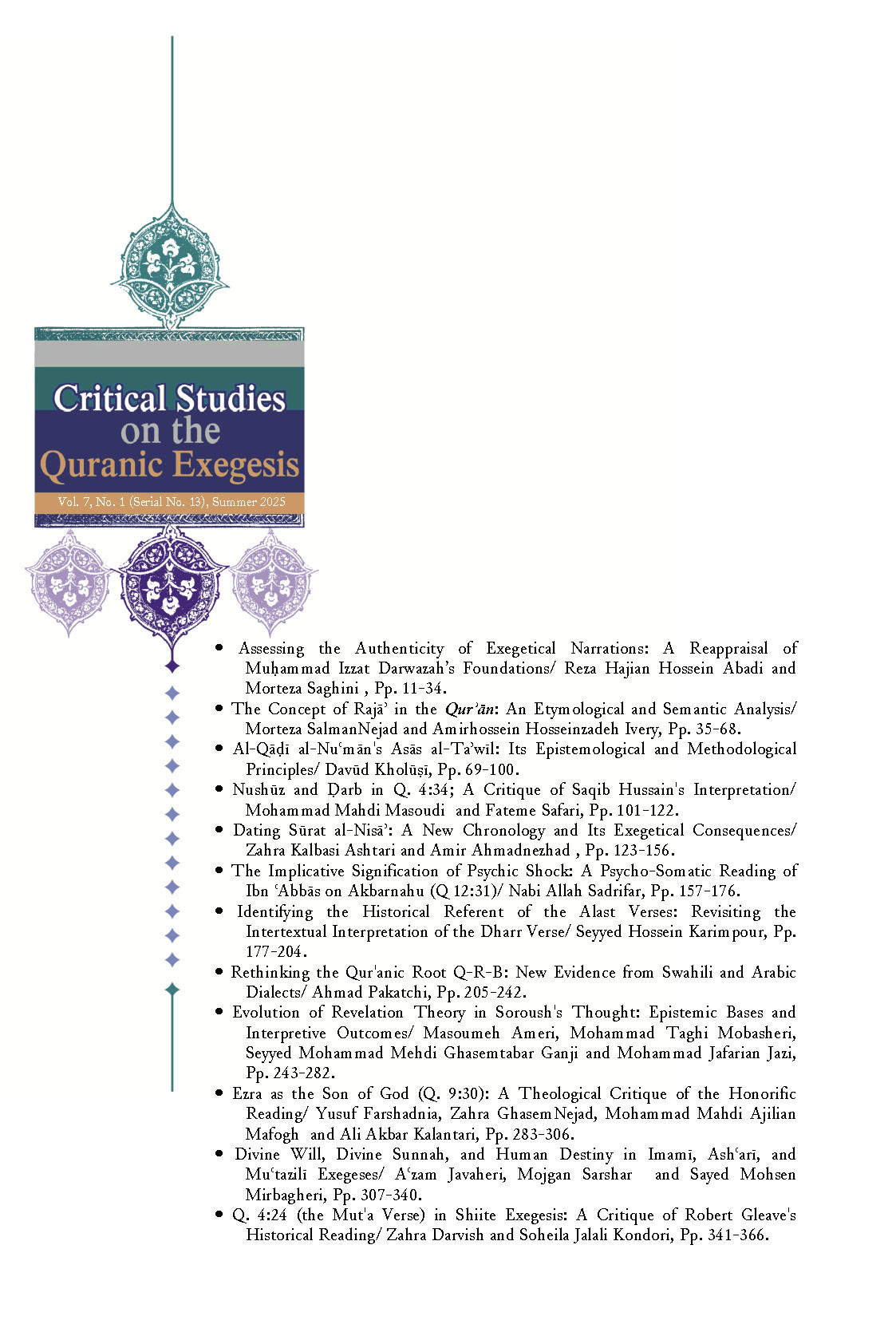
The Quran, as the foundational text of Islam, has been the subject of scholarly interpretation for over fourteen centuries. Traditional exegesis (tafsīr) has relied on classical Islamic disciplines such as ḥadīth, linguistics, and historical context, while contemporary scholarship increasingly engages with modern hermeneutical and interdisciplinary approaches. The Journal of Critical Studies in Quranic Exegesis (JCSQE) bridges these methodologies, fostering a rigorous academic space where classical Islamic sciences intersect with modern theoretical frameworks—including hermeneutics, semantics, anthropology, archaeology, and semiotics. By encouraging critical and multidisciplinary engagement with the Quranic text, JCSQE seeks to advance nuanced understandings of revelation, its historical reception, and its enduring hermeneutical challenges. The journal welcomes contributions that challenge conventional paradigms, propose innovative readings, or synthesize traditional and contemporary exegetical tools. In doing so, JCSQE aims to contribute to a dynamic, globally relevant discourse on Quranic studies—one that respects tradition while embracing scholarly progress. Through this interdisciplinary lens, JCSQE aspires to be a leading platform for scholars who interrogate the boundaries of tafsīr, offering fresh insights into the Quran’s meaning, its socio-historical context, and its interpretive possibilities across time and intellectual traditions.
Journal of Critical Studies in Quranic Exegesis is a semiannual journal in Persian (along with the inclusion of abstracts and sources of articles in English), which is published by the University of Quranic Sciences and Education (Mashhad University of Quranic Sciences) as a university based on the Quran and specialized in the field of Quranic Sciences and Education in Iran.
About the Journal
Title: The Journal of Critical Studies in Quranic Exegesis
Country and city of publication: Iran, Mashhad.
Publisher: University of Quranic Sciences and Education (Mashhad University of Quranic Sciences).
Format: electronic.
Online ISSN: 2783-5308
The method of refereeing articles: anonymous two-way, at least two referees.
Similarity finder: Samim Noor system.
Arbitration time: usually about 2 to 4 weeks
Acceptance percentage of articles: about 10% in 2019 (see magazine statistics here).
The method of issuing a certificate of acceptance of articles: electronic.
Printing status: electronic.
Publication period: Bi-quarterly.
Journal language: Farsi (with abstract and references in English).
Specialized field: studies on the interpretation of the Holy Quran (see here for the mission of the journal).
The cost of printing the article: none.
Journal type: scientific (research, promotional and review articles - with the approval of the judges and editors - are accepted).
Access to articles: free (full text).
Indexed: Yes (see here for journal profiles).
Journal email: pnat@quran.ac.ir
Scientific and literary editor: Dr. Hamed Khani (Mehrosh culture).
Compliance with the rules of the Committee on Ethics in Publication: This publication is published with respect to the rules of the Committee on Ethics in Publication (COPE) and follows the executive regulations of the Law on Prevention and Combating Fraud in Scientific Works.
Intellectual rights: All intellectual rights of the work belong to the author.
Plagiarism: To prevent plagiarism, Samim Noor software is used.
The journal's policy on how to deal with plagiarism: Whenever an article is found to be plagiarized for the journal, the journal blacklists the authors, and if their article has been published, the article is archived, and under the authors' names, the words "this is a plagiarized article" It is literary" is inserted.
Pages 11-34
10.22034/naghdeara.2026.549952.1349
Reza Hajian Hosein Abadi, Morteza Saghini
Pages 35-68
10.22034/naghdeara.2026.565642.1368
Morteza SalmanNejad, Amir Hossein Hossein Zade Ivary
Pages 69-100
10.22034/naghdeara.2026.582607.1393
Davūd Kholūṣī
Pages 101-122
10.22034/naghdeara.2026.583131.1394
Mohammad Mahdi Masoudi, Fateme Safari
Pages 123-156
10.22034/naghdeara.2026.565527.1371
Zahra Kalbasi Ashtari, Amir Ahmadnezhad
Pages 157-176
10.22034/naghdeara.2026.584798.1398
Nabi Allah Sadrifar
Pages 177-204
10.22034/naghdeara.2026.583478.1395
Seyyed Hossein Karimpour
Pages 205-242
10.22034/naghdeara.2026.592504.1415
Ahmad Pakatchi
Pages 243-282
10.22034/naghdeara.2026.589797.1411
masoumeh ameri, Mohammad Taqi Mobasheri, Seyed Mohammad Mehdi Ghasem Tabar Ganji, Mohammad Jafarian Jazi
Pages 283-306
10.22034/naghdeara.2026.584740.1397
Yusuf Farshadnia, Zahra GasemNejad, Mohammad Mahdi Ajilian Mafogh, Ali Akbar Kalantari
Pages 307-340
10.22034/naghdeara.2026.557288.1358
Aʿzam Javaheri, Mojgan Sarshar, Sayed Mohsen Mirbagheri
Pages 341-366
10.22034/naghdeara.2026.589638.1410
Zahra Darvish, Soheila Jalali Kondori


